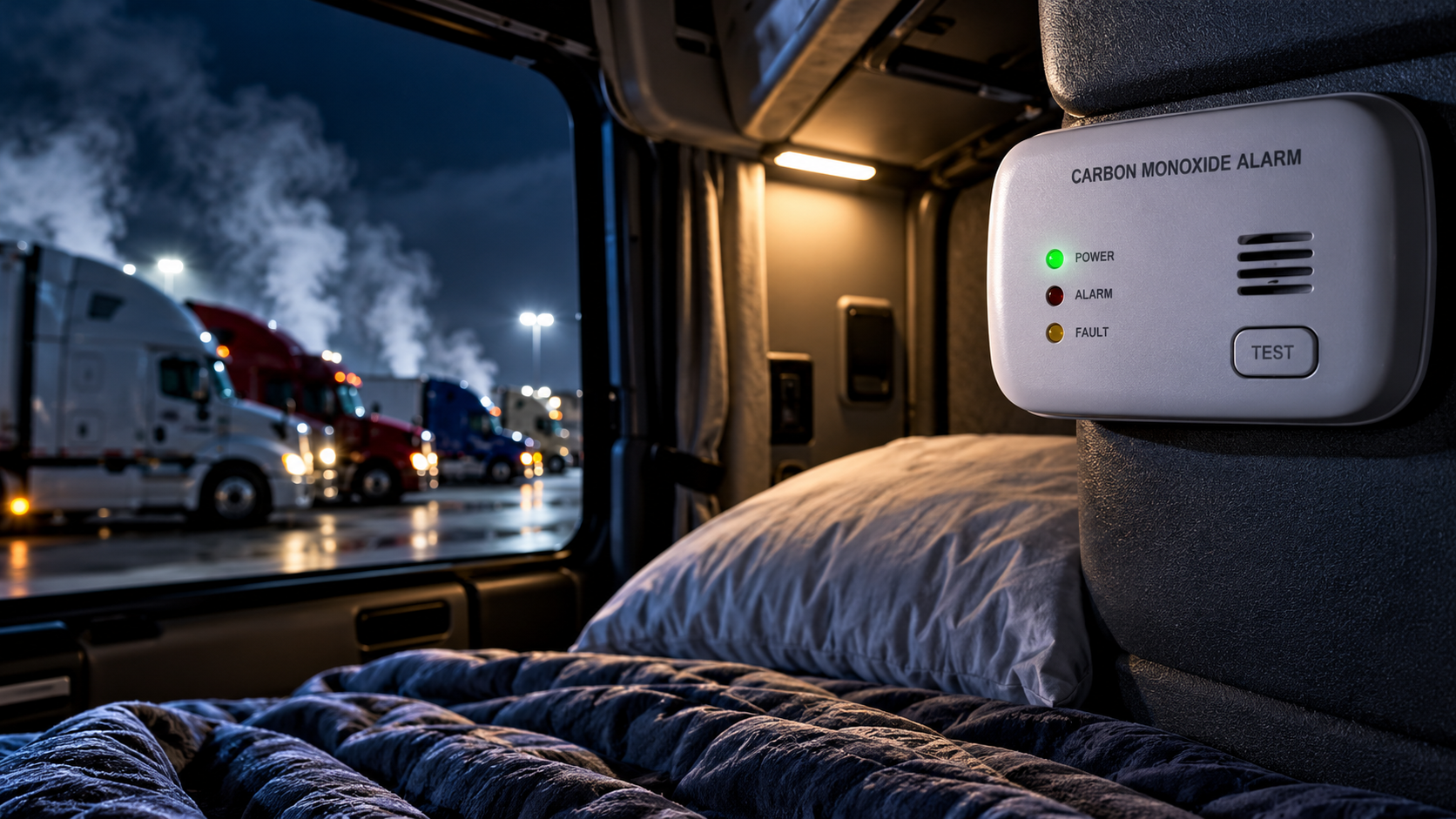
A truck driver's sleeper berth is supposed to provide a safe place to rest between runs. But a danger that cannot be seen, smelled, or tasted can turn that sleeping compartment into a deadly environment.
Carbon monoxide poisoning is a serious risk that professional drivers cannot afford to overlook, particularly when sleeping in an enclosed truck cab.
Now, a petition submitted to the Federal Motor Carrier Safety Administration (FMCSA) is calling for mandatory carbon monoxide detectors in commercial trucks equipped with sleeper berths.
The petition was received October 13, 2026. While federal regulators have not adopted the requested requirement, a documented truck driver fatality demonstrates why the issue deserves attention.
And for drivers spending nights in their trucks, the safety concern exists whether Washington ever writes a new regulation or not.
What Is the FMCSA Being Asked to Change?
According to FMCSA's official petition listing, Todd Daum submitted a request to establish a new requirement under 49 CFR Part 393 mandating carbon monoxide detector alarms in commercial motor vehicles equipped with sleeper berths.
Industry reporting published October 14 outlined several provisions included in the petition.
The requested changes include:
Installing working, battery-powered carbon monoxide alarms in sleeper areas near the driver's breathing zone.
Testing detectors every seven days.
Replacing defective alarms before dispatch.
Requiring drivers to exit the cab when an alarm activates.
Inspecting affected vehicles before returning them to service.
Restricting fuel-burning cooking stoves and portable heaters inside truck cabs.
These provisions are requests from the petitioner. They are not new FMCSA requirements.
As of October 17, the petition remains listed as open. FMCSA has not established a new federal mandate requiring carbon monoxide detectors in every sleeper-equipped commercial truck.
However, existing federal regulations already address certain carbon monoxide hazards, and a previous fatality investigation provides compelling reasons for drivers to take precautions now.
A Truck Driver's Death Shows the Danger Is Real
On January 19, 2023, a 61-year-old professional truck driver suffered fatal carbon monoxide poisoning following an extended rest period in his truck at a Washington State motor carrier terminal.
The incident was examined by the Washington State Fatality Assessment and Control Evaluation (WA FACE) program, which published its investigation narrative in June 2024.
According to the investigation, the driver had parked at the terminal for approximately 24 hours while waiting for his next dispatch. During that period, he slept overnight in the truck's sleeper berth.
The following morning, another driver encountered him near the terminal restroom.
He was disoriented and having difficulty walking, standing, and breathing.
Emergency assistance was requested, and the driver was transported to a hospital. He died shortly afterward.
A toxicology report determined that carbon monoxide poisoning caused his death.
Investigators Identified a Possible Source
The Washington investigation revealed a particularly important detail.
Investigators did not detect exhaust leaks in the truck's engine or undercarriage. Testing of the sleeper's diesel-powered bunk heater also failed to identify significant carbon monoxide levels.
Instead, investigators concluded that a single-burner butane cooking stove found inside the truck was the most likely source of the deadly exposure.
The investigation's findings were described as preliminary, and the stove was not conclusively established as the source.
Nevertheless, the case demonstrates why carbon monoxide safety involves more than inspecting a truck's exhaust system.
Equipment brought into the cab can create dangerous conditions as well.
How Carbon Monoxide Can Enter a Truck Sleeper
Carbon monoxide is produced when carbon-based fuels burn. Depending on the equipment and circumstances, it can accumulate in enclosed spaces without providing an obvious warning.
For professional truck drivers, potential sources include defective engine exhaust systems, malfunctioning fuel-burning bunk heaters, exhaust from auxiliary power units, and fumes from neighboring trucks.
Portable fuel-burning cooking or heating equipment presents another hazard.
Even parking location can matter.
Washington investigators warned that exhaust from nearby idling trucks and APUs can enter a cab despite closed windows and ventilation openings.
Drivers sometimes assume that if they cannot smell exhaust, the air inside their truck must be safe.
That assumption is dangerous.
Carbon monoxide itself has no detectable odor. A driver may be exposed without realizing anything is wrong.
Carbon Monoxide Symptoms Drivers Should Never Ignore
According to the Centers for Disease Control and Prevention (CDC), common symptoms of carbon monoxide poisoning include:
Headache
Dizziness
Weakness
Nausea or vomiting
Chest pain
Confusion
More severe exposure can cause loss of consciousness and death.
These symptoms can resemble fatigue or other illnesses, which creates an additional concern for professional drivers.
A driver who wakes up with a headache, feels unusually weak, or experiences unexplained confusion may assume the problem is poor sleep or exhaustion.
But if carbon monoxide is present, returning to the sleeper could mean continued exposure.
Sleeping individuals are particularly vulnerable because they may become seriously ill before recognizing any warning signs.
If carbon monoxide poisoning is suspected, get into fresh air immediately, call 911, and seek medical evaluation. Do not drive while symptomatic or return to the cab until the hazard has been addressed.
What Federal Regulations Already Require
Although the petition requests a new detector requirement, federal regulations already prohibit operating commercial motor vehicles under certain known carbon monoxide conditions.
Under 49 CFR § 392.66, a commercial motor vehicle cannot be dispatched or driven when certain conditions are known to exist until they have been corrected.
Those conditions include situations where an occupant has been affected by carbon monoxide, carbon monoxide has been detected inside the vehicle, or a known mechanical condition is likely to create a carbon monoxide hazard.
This regulation is already in effect.
The important distinction is that the existing rule addresses known hazards, while the new petition seeks to establish a requirement for equipment that could warn drivers before a dangerous exposure becomes apparent.
A driver sleeping inside a truck may have no practical way of knowing that carbon monoxide is accumulating without a suitable detection device.
That is the safety gap the petition seeks to address.
Practical Precautions Truck Drivers Can Take Today
The Washington State fatality investigation identified several preventive measures that drivers and motor carriers should consider.
Use a Carbon Monoxide Detector Designed for Vehicles
Washington investigators recommended installing battery-powered carbon monoxide alarms in truck cabs and sleeper berths.
Not every household detector is necessarily suitable for commercial truck environments.
Drivers should select equipment specifically designed for vehicle applications and follow the manufacturer's instructions for installation, placement, testing, maintenance, and replacement.
A detector provides an additional warning measure. It does not eliminate the underlying hazard.
Keep Fuel-Burning Cooking and Heating Equipment Out of the Cab
Portable butane and propane stoves may seem convenient, particularly for drivers trying to prepare meals without leaving the truck.
But operating fuel-burning equipment inside an enclosed cab or sleeper can create a potentially fatal carbon monoxide hazard.
Washington investigators recommended prohibiting these devices inside truck cabs, sleepers, and trailers.
Having a carbon monoxide detector does not make operating these devices inside the truck safe.
Pay Attention to Nearby Exhaust
Truck parking is limited in many parts of the country, and drivers cannot always choose an ideal parking location.
Still, when practical, avoid parking where exhaust from neighboring idling trucks or APUs may enter your cab.
Closed windows do not guarantee protection.
Maintain Exhaust Systems and Bunk Heaters
Regular inspections and preventive maintenance are essential.
Engine exhaust leaks, damaged components, and defective fuel-burning heating equipment can create hazardous conditions.
Drivers should report suspected problems promptly and ensure necessary repairs are completed.
A carbon monoxide alarm should supplement proper maintenance, not replace it.
Never Ignore an Alarm
If a carbon monoxide alarm activates, treat it as a potential emergency.
Stop safely if the truck is moving, exit into fresh air, and arrange for the vehicle to be professionally inspected before it is used again.
If poisoning is suspected, call 911.
Do not simply silence the alarm, assume it malfunctioned, and return to sleep.
What Happens Next With the FMCSA Petition?
The petition is currently an open request for regulatory action.
That does not mean FMCSA has approved it, issued a proposed rule, or established a timetable for implementation.
The agency may evaluate the request and determine whether further action is appropriate.
For now, there is no new federal requirement mandating carbon monoxide detectors in all commercial truck sleeper berths as a result of this petition.
But the larger safety question does not depend on what federal regulators decide.
Professional truck drivers routinely spend hours sleeping in enclosed spaces surrounded by engines, exhaust systems, heating equipment, and other potential combustion sources.
The Washington fatality investigation illustrates how dangerous carbon monoxide exposure can become and how difficult it may be to recognize before serious harm occurs.
The Bottom Line
A truck's sleeper berth is more than a place to grab a few hours of rest. For many drivers, it serves as their home away from home.
That makes protecting the air inside it just as important as maintaining the equipment underneath it.
The FMCSA petition may eventually lead to additional requirements, or it may not.
Either way, carbon monoxide poisoning is an established hazard, and drivers should not have to wait for another regulation to take reasonable precautions.
A safe night's sleep should never depend on whether a driver can detect a danger that gives no warning.
Sources
Federal Motor Carrier Safety Administration, Open Petitions for Rulemaking, Todd Daum petition received October 13, 2026.
Washington State Department of Labor & Industries, Truck Driver Poisoned by Carbon Monoxide in Cab, WA FACE Report 71-254-2024s, June 1, 2024.
49 CFR § 392.66, Carbon Monoxide; Use of Commercial Motor Vehicle When Detected.
Centers for Disease Control and Prevention, Carbon Monoxide Poisoning Basics, updated January 12, 2026.
CDLLife, Truck Driver Petitions FMCSA for Rule to Require Carbon Monoxide Detectors in Sleeper Berths, October 14, 2026.