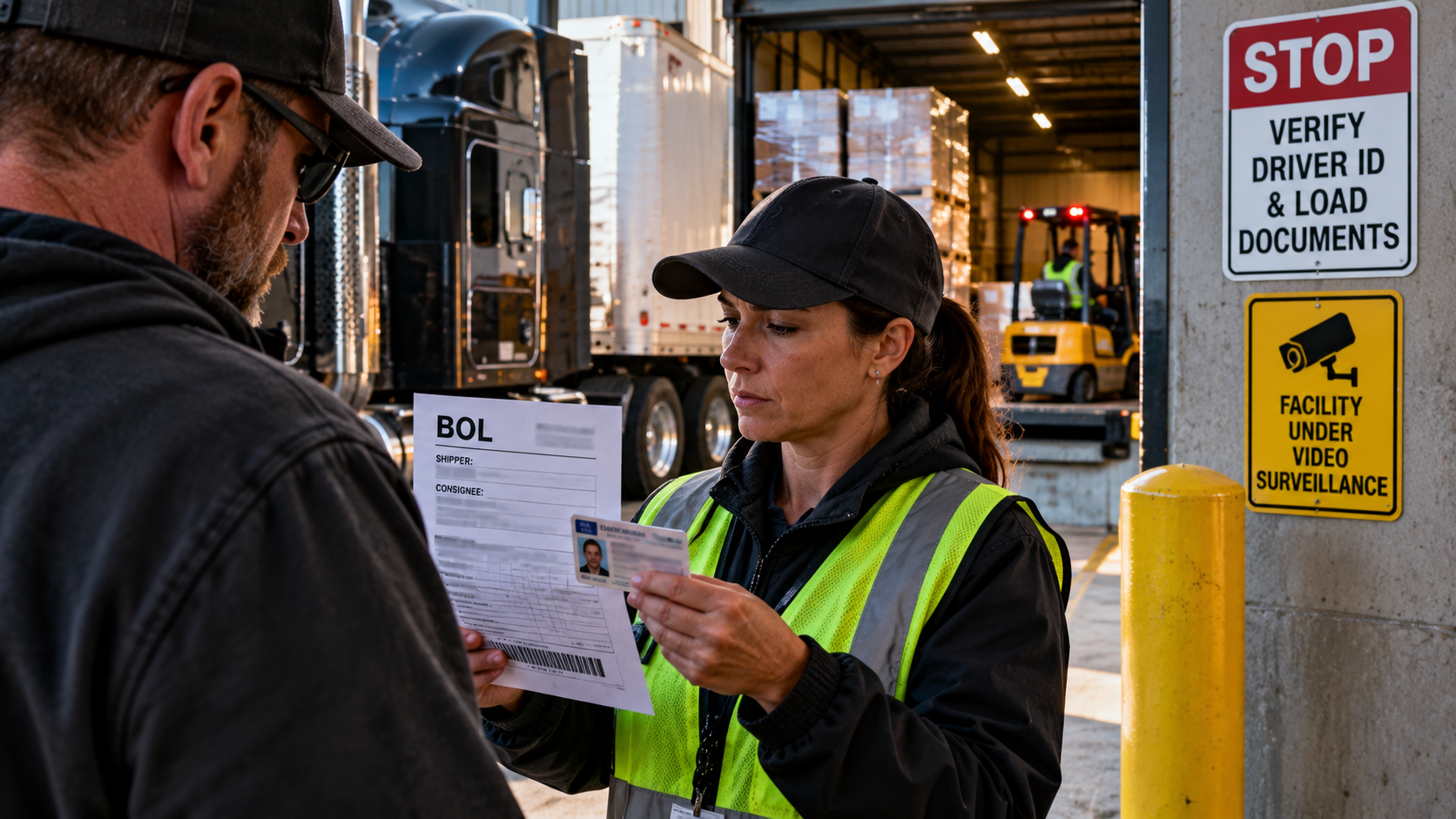
When most truck drivers think about cargo theft, they picture somebody cutting a trailer seal, breaking a lock, or stealing an entire tractor-trailer from a parking lot.
Those things still happen.
But some freight thieves have figured out another way to steal a load.
They show up at the shipper, present what appears to be legitimate paperwork, and drive away with freight they were never authorized to haul.
No broken lock. No damaged trailer. Sometimes, no immediate indication that anything is wrong.
By the time the real carrier arrives to pick up the shipment, the freight may already be hundreds of miles away.
Welcome to one of the more troubling sides of modern cargo theft: carrier impersonation and fraudulent freight pickups.
Cargo Theft Has Become More Than a Parking-Lot Problem
Traditional cargo theft usually involves physically taking freight from a trailer, warehouse, or parked vehicle.
Strategic cargo theft takes a different approach.
Instead of forcing their way into a trailer, criminals manipulate the freight transportation process itself.
They may impersonate a legitimate motor carrier, use stolen business credentials, alter pickup instructions, or convince a shipping facility that they are authorized to receive a shipment.
In some cases, the freight is handed directly to the criminals.
The shipment leaves the facility through what appears to be a normal pickup.
The theft may not become apparent until the actual carrier arrives, a delivery appointment is missed, or someone discovers that the load was transferred to an unauthorized party.
For drivers and owner-operators, this creates a problem that extends beyond protecting the trailer doors.
It means protecting the identity and authorization of the people handling the freight.
How Carrier Impersonation Works
Consider a common trucking situation.
A broker arranges for a legitimate carrier to transport a load. The carrier receives the pickup information, and a driver is dispatched to the shipper.
Under normal circumstances, the driver checks in, verifies the load information, receives the shipping documents, and departs.
Now imagine a criminal has obtained enough information to impersonate that carrier.
The criminal may know the pickup location, appointment time, commodity, destination, and carrier identification details.
They arrive before the authorized driver and present information that appears to match the shipment.
If the shipping facility relies on paperwork alone, the fraudulent driver may be allowed to take the freight.
The actual carrier may have no idea its identity has been used until the legitimate driver reaches the facility.
This is one reason cargo security cannot depend exclusively on whether someone knows a load number.
A load number can be stolen, forwarded, or obtained through compromised communications.
Knowing the shipment details is not the same as being authorized to haul the shipment.
Stolen Email Accounts and Altered Instructions
Freight transportation depends heavily on electronic communication.
Brokers, carriers, dispatchers, warehouses, and drivers routinely exchange pickup numbers, rate confirmations, appointment details, and delivery instructions.
Criminals can exploit that communication.
A compromised email account may allow someone to send instructions that appear to come from a legitimate business.
Fraudulent messages may request a change in driver, equipment, pickup time, or delivery location.
Sometimes the change appears minor.
A different phone number. A replacement driver. A new email address. An updated pickup reference.
Individually, those changes may not seem alarming.
But when a criminal controls the communication channel, those details can help redirect freight.
Drivers should understand that a message appearing to come from dispatch or a broker is not automatically legitimate.
Unexpected changes involving freight custody or delivery instructions deserve verification through an established, trusted contact method.
Fake Drivers, Fake Trucks, and Real Freight
Some schemes involve more than stolen paperwork.
Industry security reporting has described criminals using falsified identification, altered truck markings, and other methods to appear connected to a legitimate motor carrier.
That creates a difficult situation for shipping facilities.
A tractor with familiar company markings does not necessarily prove that the person operating it is authorized to pick up a particular shipment.
Likewise, a driver presenting identification or a carrier's USDOT number does not automatically establish authorization.
Proper verification requires matching the shipment to the actual carrier assignment and the driver or equipment authorized for pickup.
For legitimate drivers, additional verification procedures may sometimes feel inconvenient.
But there is a reason a warehouse might ask for more than a pickup number.
The objective should be to prevent unauthorized freight from leaving the property without creating unnecessary obstacles for properly dispatched drivers.
Why Owner-Operators and Small Carriers Should Pay Attention
Carrier impersonation can be especially damaging to a small trucking business.
A criminal may use the company's name, operating authority information, or stolen credentials to arrange or collect freight.
The legitimate owner may not discover the problem until a broker calls about a shipment the company never accepted.
That can lead to disputes, damaged business relationships, administrative problems, and potential financial losses.
Public carrier information is available through federal transportation databases.
That information serves legitimate purposes, including helping customers and brokers verify motor carriers.
But publicly available information can also be misused by criminals attempting to appear legitimate.
For that reason, owner-operators should pay attention to unusual activity involving their business identities.
Unexpected load confirmations, unfamiliar dispatch communications, changes to contact information, or inquiries about shipments they never booked should be investigated promptly.
What Drivers Should Verify Before Leaving a Shipper
Drivers aren't expected to conduct criminal investigations at every pickup.
But a few consistent habits can help prevent mistakes and identify suspicious circumstances.
Confirm the Shipment
Make sure the pickup information matches the load you were actually dispatched to haul.
Verify the shipper, pickup reference, destination, trailer information, and any special instructions.
If something doesn't match, contact dispatch before leaving.
Question Unexpected Changes
A last-minute destination change, unfamiliar contact number, or instruction to transfer freight to another vehicle should not be accepted without verification.
Contact the appropriate dispatcher, carrier representative, or broker using a known number rather than relying solely on information contained in the suspicious message.
Protect Dispatch and Business Credentials
Avoid sharing carrier login credentials, account access information, or sensitive shipping documents with unauthorized individuals.
Be cautious about unsolicited messages requesting account verification or immediate action.
Document Trailer and Seal Information
Record trailer numbers, seal numbers when applicable, and shipping-document discrepancies according to company procedures.
If a seal is missing, damaged, or different from the paperwork, address the discrepancy before proceeding.
Report Suspicious Activity
If you believe someone is attempting to impersonate your carrier or redirect a shipment, notify the appropriate carrier or broker representative immediately.
Do not confront suspected criminals or attempt to recover freight yourself.
What If You Arrive and Someone Already Picked Up Your Load?
Imagine arriving at a distribution center and hearing the shipping clerk say, "That load already left."
Your first reaction might be that dispatch sent you to the wrong location or gave you the wrong appointment.
Sometimes that really is the explanation.
But it could also indicate a fraudulent pickup.
Before drawing conclusions, verify the shipment number, appointment, and assigned carrier.
Contact dispatch or the broker through an established number.
Ask the shipping facility to preserve relevant pickup records, check-in information, and surveillance footage if a fraudulent pickup is suspected.
Document the time, location, and information provided.
The carrier, broker, shipper, insurer, and law enforcement may need to coordinate the investigation.
A driver should not independently accuse warehouse employees or other drivers of theft based on incomplete information.
The immediate priority is preserving accurate information and notifying the proper parties.
Cargo Theft Doesn't Always Involve the Driver
One important point deserves emphasis.
When freight disappears, that does not automatically mean the truck driver was involved.
A shipment may be stolen through compromised communications, fraudulent documentation, unauthorized changes to pickup instructions, or failures elsewhere in the transportation chain.
In other cases, cargo may be physically stolen while equipment is unattended.
Investigators must establish what actually occurred.
Drivers should protect themselves by maintaining accurate records, following established procedures, and reporting discrepancies promptly.
Documentation is not just paperwork.
It can help establish where the freight was, who had custody, and when something went wrong.
The Industry Is Paying Attention
Cargo-security specialists have increasingly focused on fraudulent pickups and impersonation schemes.
Industry reporting in October 2026 described the use of stolen carrier email accounts, falsified identification, manipulated pickup instructions, and altered vehicle markings.
These reports illustrate how organized cargo theft can exploit legitimate freight operations.
The exact frequency and financial impact of particular schemes depend on the data source and reporting methodology.
But the underlying security concern is clear.
Protecting freight now requires attention to both physical equipment and the information used to authorize transportation.
A locked trailer is important.
So is knowing that the person receiving the freight is actually supposed to be there.
The Bottom Line
Cargo theft isn't always somebody breaking into a trailer at a truck stop.
Sometimes the criminal walks into a shipping office, presents convincing information, and leaves with an entire load.
Professional drivers, owner-operators, brokers, and shipping facilities all have roles in preventing that from happening.
Verify unexpected changes. Protect business credentials. Keep accurate pickup and delivery records. Report discrepancies before they become bigger problems.
And remember one simple principle:
Just because somebody knows the load number doesn't mean they own the right to haul the load.
Sources and Further Reading
FreightWaves: Freight Fraud Gets More Strategic Heading Into Peak Season, October 19, 2026
Transport Topics: Cargo Theft Becomes the New Normal, October 20, 2026
FMCSA: SAFER Company Snapshot
FMCSA: Registration and Licensing
This article provides general cargo-security education. Specific reporting, insurance, and investigation procedures may vary depending on the carrier, shipment, and circumstances.