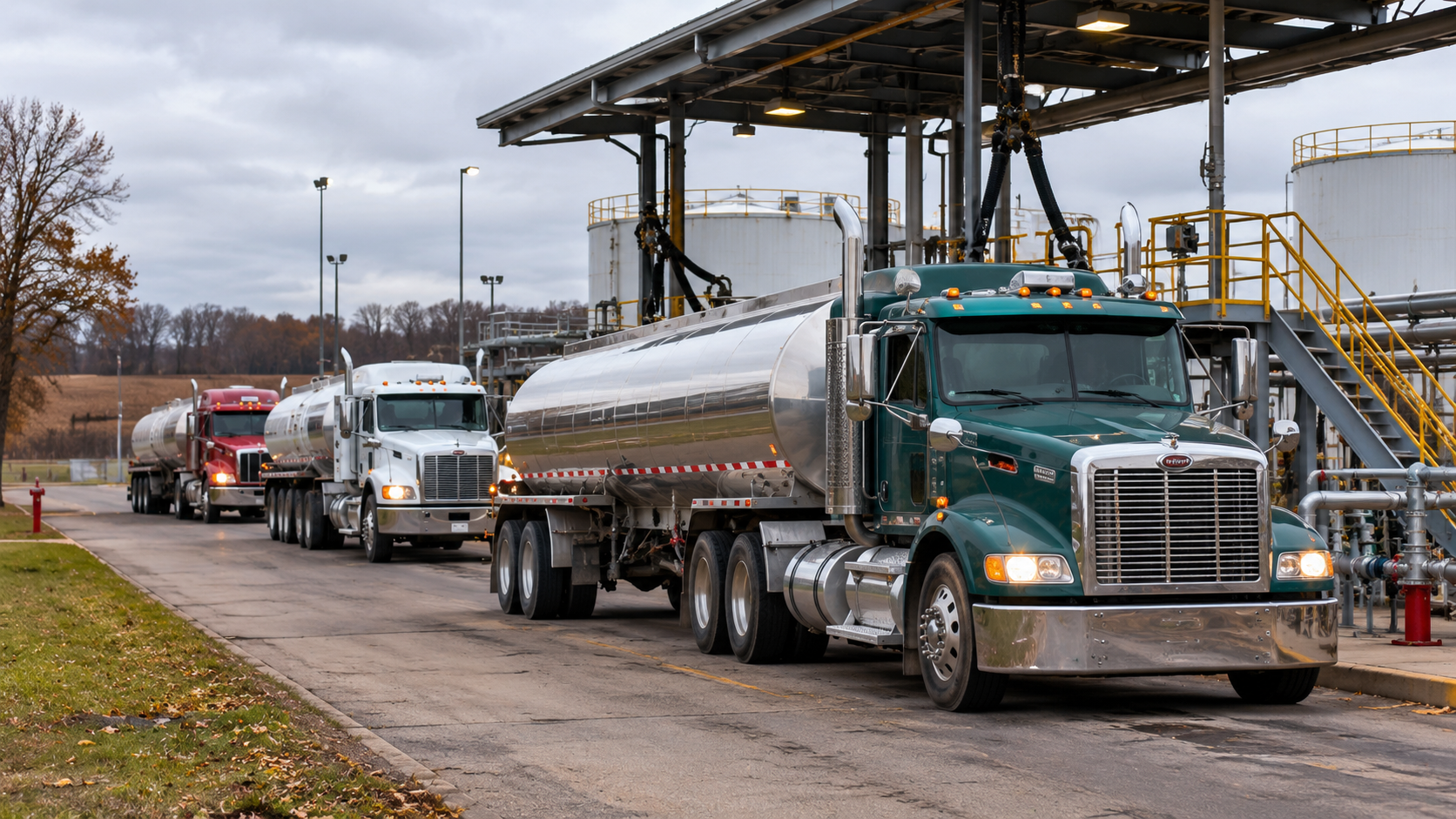
Iowa has temporarily suspended certain state hours-of-service restrictions for commercial drivers transporting motor fuels as refinery maintenance, terminal supply problems, and heavy agricultural demand complicate fuel deliveries.
Governor Kim Reynolds issued the emergency proclamation October 29, 2026. The relief took effect immediately and is scheduled to expire at 11:59 p.m. on November 28, unless extended or terminated earlier.
The order covers qualifying deliveries of diesel, gasoline, gasoline blends, ethanol, and biodiesel into or within Iowa.
For fuel haulers, the change provides additional operating flexibility, but it does not eliminate driver qualification requirements, fatigue protections, or other applicable safety regulations.
Importantly, a separate federal hours-of-service waiver is also in effect for qualifying interstate fuel transportation, with a different expiration date and operating conditions.
Why Iowa Issued the Emergency Proclamation
Iowa's fuel transportation problems have developed from several overlapping conditions.
According to the governor's proclamation, refinery and terminal maintenance have strained fuel availability while agricultural demand remains elevated.
The state also reported that commercial fuel haulers have been traveling farther and spending more time waiting at terminals to obtain product.
Those delays have practical consequences for drivers.
A fuel transport that normally makes several deliveries from a nearby terminal may have to travel to a more distant location when product is unavailable locally.
Additional driving time, terminal congestion, and loading delays can consume a substantial portion of a driver's available duty hours before the deliveries are completed.
Local reporting from KCCI and Iowa Capital Dispatch described drivers waiting for hours at terminals, with some fuel haulers completing substantially fewer loads per day than usual.
Industry representatives also connected the increased demand to Iowa's delayed agricultural harvest.
The emergency proclamation is intended to improve the movement of available fuel by providing qualified carriers and drivers more flexibility to complete deliveries.
It does not, by itself, increase refinery production or eliminate terminal supply constraints.
Which Fuel Deliveries Qualify?
Iowa's October 29 proclamation temporarily suspends the hours-of-service provisions of Iowa Code Section 321.449 for crews and drivers delivering specified fuels into or within the state.
The covered products are:
Diesel fuel
Gasoline
Gasoline blends
Ethanol
Biodiesel
The proclamation applies statewide to qualifying transportation associated with the declared fuel emergency.
It is not a general hours-of-service exemption for every commercial truck operating in Iowa.
Drivers hauling unrelated freight, including ordinary dry van, refrigerated, or flatbed shipments, do not qualify simply because they travel through the state.
The type of freight being transported and the applicable operating conditions determine whether the relief is available.
Fatigued Drivers Are Still Prohibited From Operating
One of the most important provisions in Iowa's proclamation concerns driver fatigue.
The order specifically prohibits motor carriers from requiring or allowing fatigued or ill drivers to operate commercial motor vehicles.
A driver who informs the carrier that immediate rest is necessary must receive at least 10 consecutive hours off duty before being required to return to service.
The proclamation also provides another protection for drivers accumulating extended duty hours.
When a driver has been on duty for more than 70 hours during any eight consecutive days, the motor carrier must provide at least 34 consecutive hours off if the driver requests it.
These requirements are part of the emergency relief itself.
The suspension of specified HOS provisions is not permission to operate indefinitely or disregard driver fitness for duty.
CDL, Drug Testing, and Insurance Requirements Remain
Iowa's emergency proclamation does not suspend the full range of federal commercial motor vehicle safety requirements.
The order expressly preserves several major regulatory obligations, including:
49 CFR Part 382: Controlled substances and alcohol testing requirements.
49 CFR Part 383: Commercial driver's license requirements.
49 CFR Part 387: Minimum financial responsibility requirements.
Other federal requirements: Regulations not specifically addressed by the emergency proclamation remain applicable.
Motor carriers operating under an applicable out-of-service order are also excluded from the relief under the conditions stated in the proclamation.
Other Iowa laws and administrative requirements not specifically suspended remain in effect.
For drivers and carriers, this means the emergency order provides limited flexibility in qualifying fuel transportation rather than a blanket suspension of commercial trucking regulations.
A Separate Federal Fuel-Hauling Waiver Is Already in Effect
There is another important consideration for interstate fuel haulers.
The Federal Motor Carrier Safety Administration issued an amended federal hours-of-service waiver on October 15, 2026, covering qualifying transportation of gasoline, diesel fuel, ethanol, and denatured ethanol in interstate commerce.
The federal waiver is effective from September 16 through December 16, 2026.
It temporarily waives specified hours-of-service limitations under 49 CFR Section 395.3, subject to federal conditions.
Among the federal waiver's stated operating restrictions:
A driver may not exceed 16 hours of driving in any 24-hour period.
The waiver requires a minimum six-consecutive-hour sleeper-berth break during each 24-hour period.
The federal waiver applies to qualifying interstate fuel transportation, not unrelated freight.
The federal waiver's conditions remain important even when a driver is also operating under another exception or emergency declaration.
These are requirements of the separate FMCSA waiver and should not be confused with the conditions of Iowa's state proclamation.
Two Different Expiration Dates Matter
Drivers and motor carriers need to distinguish the Iowa emergency proclamation from FMCSA's federal waiver.
Iowa emergency proclamation
Issued: October 29, 2026
Scheduled expiration: November 28, 2026, at 11:59 p.m.
Coverage: Specified state HOS restrictions for qualifying fuel deliveries into or within Iowa
Authority: Iowa Governor's emergency proclamation
FMCSA federal fuel-hauling waiver
Original effective date: September 16, 2026
Amended waiver issued: October 15, 2026
Scheduled expiration: December 16, 2026
Coverage: Specified federal HOS restrictions for qualifying interstate fuel transportation
Authority: Federal Motor Carrier Safety Administration
The existence of Iowa's emergency proclamation does not automatically replace the federal waiver's terms.
Likewise, the federal waiver does not make every Iowa trucking operation eligible for emergency HOS relief.
For interstate operations, the federal waiver also contains a preemption provision addressing conflicting state requirements applicable to carriers and drivers operating under its terms.
Understanding which authority applies to a particular movement is essential when determining the available relief and its limitations.
What Happens When the Emergency Relief Ends?
Iowa's proclamation addresses the transition back to normal hours-of-service accounting.
Under its stated conditions, a driver who has received at least 34 consecutive hours off duty may reset the applicable on-duty and 60/70-hour calculations when the proclamation expires or when the driver is relieved of emergency-assistance responsibilities.
That provision does not eliminate the need to follow other applicable federal requirements or the conditions of the separate FMCSA waiver.
Unless Iowa extends its proclamation in writing, the state relief is scheduled to end November 28.
The federal waiver currently has a later expiration date of December 16, subject to any subsequent FMCSA action.
What This Means for Professional Drivers
For qualifying fuel haulers, Iowa's emergency order may provide additional flexibility when terminal congestion, longer trips, and product availability interfere with normal delivery schedules.
However, the relief has defined limits.
Drivers remain subject to the proclamation's fatigue protections and applicable qualification, drug-testing, financial responsibility, and other safety requirements.
Interstate fuel haulers must also account for the separate federal waiver and its specific operating conditions.
For drivers hauling freight unrelated to the fuel emergency, the Iowa proclamation does not create a general exception from normal hours-of-service requirements.
The larger issue remains the fuel distribution problem itself.
Extended terminal waits and longer trips can reduce the number of deliveries a driver completes even when equipment and fuel demand are available.
Temporary regulatory relief may help qualified carriers move fuel more efficiently, but the actual improvement in fuel availability will depend on terminal operations, supply conditions, and transportation capacity.
Truck Stop Talk will continue monitoring official changes to the Iowa proclamation and FMCSA's federal fuel-hauling waiver.
Sources
Office of Iowa Governor Kim Reynolds, October 29, 2026: Emergency Fuel Transportation Announcement
Office of Iowa Governor Kim Reynolds: Full Emergency Proclamation and Operating Conditions
Federal Motor Carrier Safety Administration, October 15, 2026: Amended Federal Hours-of-Service Waiver for Gasoline and Diesel Fuel Transportation
Iowa Department of Public Safety: Commercial Motor Vehicle Unit and Emergency Proclamations
KCCI, October 29, 2026: Iowa Truck Drivers Navigate Diesel Terminal Delays
Iowa Capital Dispatch reporting via KCRG, October 29, 2026: Reynolds Pauses Driver Regulations to Improve Fuel Transportation