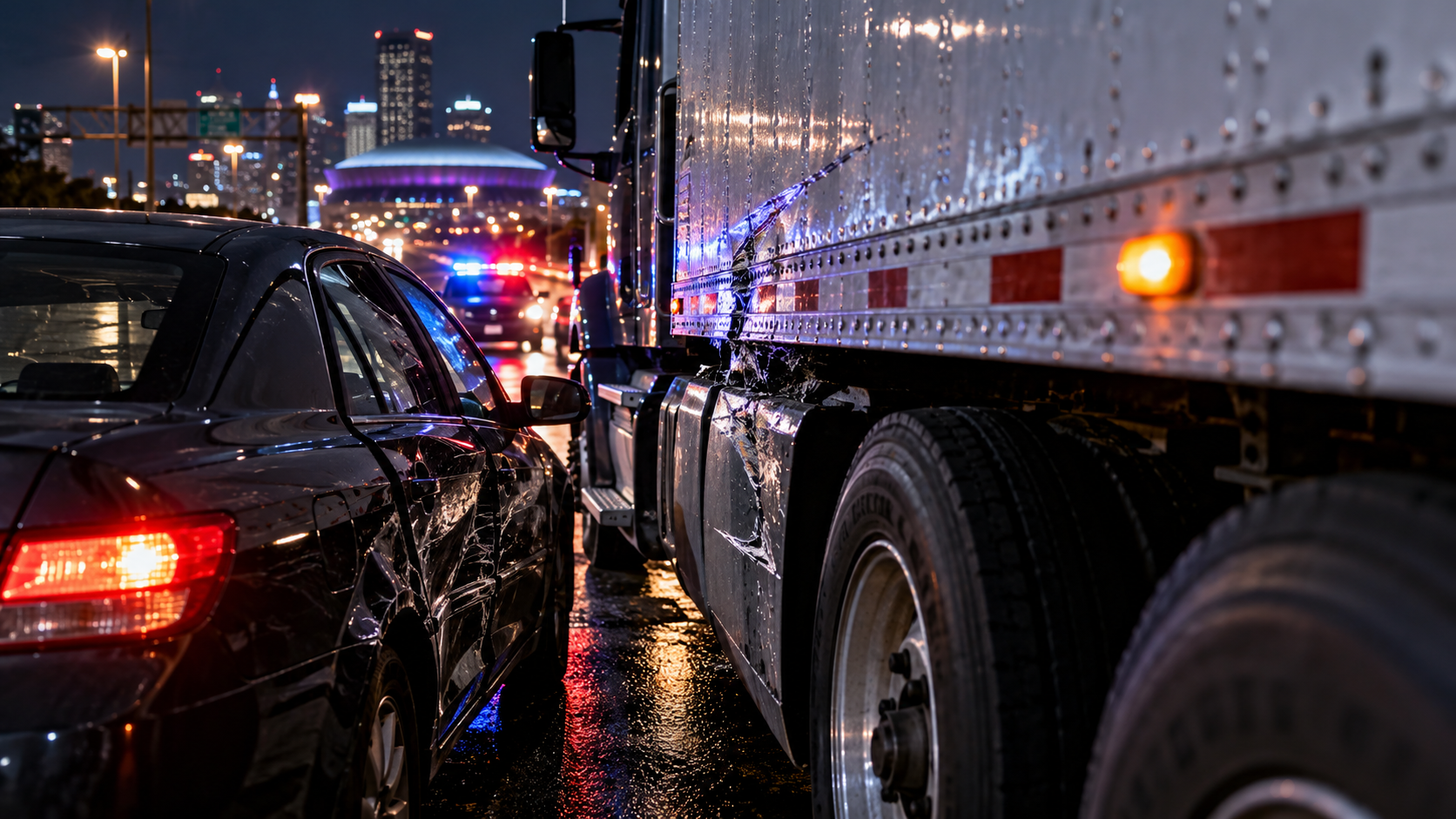
A former New Orleans personal-injury attorney has been sentenced to federal prison for participating in an organized scheme that deliberately staged traffic collisions involving commercial tractor-trailers, then used fraudulent injury claims to collect insurance settlements.
On October 15, 2026, U.S. District Judge Nanette Jolivette Brown sentenced Danny Patrick Keating Jr. to 32 months in federal prison, followed by three years of supervised release. He was also ordered to pay $657,405.34 in restitution.
The U.S. Department of Justice announced the sentencing on October 16.
Keating's conviction is part of a much larger federal investigation into staged crashes in the New Orleans area, commonly known as Operation Sideswipe. The investigation has resulted in charges against 63 defendants.
But behind the courtroom proceedings is a troubling reality for professional truck drivers.
These weren't simply questionable insurance claims filed after ordinary traffic accidents. Federal investigators uncovered an operation in which people intentionally caused collisions with commercial trucks, manipulated the circumstances, and pursued financial settlements based on manufactured claims.
For a truck driver caught in the middle, what appeared to be an ordinary accident could actually have been a carefully arranged trap.
How the Staged Truck Crashes Worked
According to federal prosecutors, participants in the scheme had specific roles.
One individual, commonly referred to as the slammer, intentionally caused the collision.
Another participant, sometimes called a spotter, assisted in carrying out the plan or helped the slammer leave the scene.
Other individuals occupied the passenger vehicle and later participated in false accounts of what happened.
Investigators documented situations in which commercial trucks were targeted while changing lanes. The slammer would position a passenger vehicle near a tractor-trailer's blind spot and deliberately cause contact.
In some cases, collisions were staged at night or in locations where independent witnesses were less likely to be present.
The circumstances could make it appear that the truck driver had improperly changed lanes and struck another vehicle.
That appearance was exactly what the conspirators wanted.
The Driver Behind the Wheel Wasn't Always the Person Reporting the Crash
One of the more disturbing details uncovered by investigators involved switching drivers after a staged collision.
Federal prosecutors described an incident in which the individual who intentionally struck a tractor-trailer left the scene in another vehicle.
Someone else then occupied the driver's seat of the damaged passenger vehicle before authorities arrived.
That person could subsequently identify themselves as the driver and provide a false account of the collision.
In other cases, accomplices presented themselves as witnesses and blamed the commercial truck driver.
For an innocent professional driver, this created a serious problem.
The vehicle damage, statements from supposed witnesses, and subsequent insurance claims could all appear to support an account that was deliberately fabricated.
The Money Behind the Operation
Federal prosecutors reported that Keating was involved in 31 staged collisions and represented 77 plaintiffs connected to those crashes.
Of those collisions, 17 resulted in settlements.
Keating and his clients received approximately $1.5 million in settlement proceeds, with Keating retaining approximately $358,000 in attorney fees.
These figures relate to Keating's participation in the operation, not the entire multiyear federal investigation.
According to the Justice Department, Keating admitted knowingly paying an accomplice for staged collisions involving tractor-trailers and subsequently representing individuals involved in those collisions through fraudulent legal claims.
He pleaded guilty on June 17, 2021, to conspiracy to commit mail and wire fraud.
The original federal indictment also described alleged payments to individuals who helped arrange staged crashes.
Prosecutors alleged that one organizer received payments calculated according to the number of passengers involved, including $1,000 per passenger for staged tractor-trailer collisions and $500 per passenger for other staged crashes.
Those details came from the original allegations and should be distinguished from the conduct established through Keating's guilty plea.
The financial incentive was straightforward.
Create a collision, manufacture or exaggerate injuries, pursue a legal claim, and collect a settlement.
The Financial Damage Extended Beyond One Attorney
Operation Sideswipe exposed the financial consequences of deliberately targeting commercial vehicles.
In one separate case connected to the broader investigation, the Justice Department reported that a staged collision resulted in a $545,000 settlement paid by a tractor-trailer's owner and insurer.
A participant in that case subsequently received a federal prison sentence and was ordered to pay restitution.
That is a documented financial loss, not merely an estimate of what insurance fraud might cost the trucking industry.
Beyond settlement payments, a serious collision claim can create additional expenses for a motor carrier.
Those may include accident investigations, legal defense, equipment downtime, insurance administration, and potential future insurance consequences.
For the professional driver, the stakes can be personal as well.
An accident investigation may raise questions about driving performance, safety records, employment, and professional reputation.
The federal cases illustrate why accurate evidence is so important when determining what actually happened.
A Federal Investigation That Reached Far Beyond Staged Accidents
The New Orleans investigation eventually exposed more than individual drivers intentionally striking tractor-trailers.
On March 20, 2026, a federal jury convicted two additional personal-injury attorneys, Vanessa Motta and Jason Giles, along with their respective law firms and another co-conspirator, Diamanike Stalbert.
According to the Justice Department, the wider operation involved fraudulent lawsuits, unnecessary medical procedures intended to increase claim values, and attempts to interfere with the federal investigation.
The case also included a particularly serious development involving a cooperating witness.
Cornelius Garrison, who had cooperated with federal investigators, was murdered in September 2020.
Ryan J. Harris later pleaded guilty to offenses connected to that killing, including causing death through the use of a firearm.
That homicide was part of the wider federal investigation. Keating's October 2026 prison sentence was for the fraud conspiracy, not for murder or the separate offenses committed by other defendants.
The broader proceedings demonstrate how extensive and serious the operation became.
What Professional Truck Drivers Can Learn From Operation Sideswipe
There is an important distinction between the staged collisions uncovered in New Orleans and ordinary traffic accidents.
Not every sideswipe collision is suspicious, and a driver should never assume that another motorist is committing fraud simply because an accident occurred.
But the federal investigation demonstrates that deliberately manufactured collisions can happen.
Professional drivers should understand how to protect themselves when the circumstances of an accident are disputed.
Preserve Dashcam Footage Immediately
A properly functioning dashcam can provide valuable evidence when accounts of a collision conflict.
Drivers should preserve the original footage from before, during, and after an accident.
Do not assume that a camera will retain the recording indefinitely. Some systems automatically overwrite older files.
Where available, footage from multiple camera angles may help establish vehicle positions and movements.
Document the Accident Scene
When it is safe to do so, photograph the vehicles, damage, license plates, lane markings, and surrounding road conditions.
Record the location, time, and other relevant details.
Photographs taken before vehicles are moved, when safe and lawful, may help investigators reconstruct what happened.
Identify Independent Witnesses
Operation Sideswipe demonstrated that individuals involved in a scheme could present themselves as independent witnesses.
Drivers should obtain contact information from actual witnesses when possible and provide those details to responding authorities and their motor carrier.
Do not assume that someone who approaches the scene necessarily witnessed the collision.
Report Inconsistencies Without Making Accusations
If accounts of the accident conflict, document those differences accurately.
For example, questions about who was driving a passenger vehicle or where someone was positioned before the collision may be important to investigators.
But inconsistencies alone do not prove fraud.
Drivers should report observations rather than speculate about another person's intentions.
Notify the Carrier and Preserve Records
Follow company accident-reporting procedures and notify the appropriate parties promptly.
Preserve relevant documentation, including photographs, video, written statements, and communications.
If fraud is suspected, report the concern through the carrier, insurer, law enforcement, or appropriate investigative channels.
Do not confront individuals at the scene over suspected fraud.
Why This Case Matters to the Trucking Industry
Commercial truck drivers already operate in an environment where a serious traffic collision can have substantial consequences.
The size and weight of tractor-trailers, the complexity of accident investigations, and the financial exposure associated with injury claims make commercial vehicles attractive targets for certain types of fraud.
Operation Sideswipe revealed an organized effort to exploit those circumstances.
The federal investigation documented deliberate collisions, false statements, fraudulent legal claims, and substantial insurance settlements.
And while Keating's sentencing represents another completed chapter in the prosecution, it also provides an important reminder that the physical evidence of a crash does not always tell the entire story.
Sometimes, the accident itself was intentional.
The Bottom Line
A professional truck driver can follow traffic laws, operate defensively, and still become the target of someone determined to manufacture an accident.
That's what makes the New Orleans staged-crash investigation so troubling.
The people involved weren't simply trying to avoid responsibility for an accident. They were deliberately creating collisions and attempting to turn them into financial settlements.
Keating's 32-month prison sentence is another example of federal authorities holding participants accountable.
For professional drivers, the lesson is practical.
Protect the evidence. Document the facts. And never assume that everyone involved in a collision is necessarily telling the same story about how it happened.
When your driving record, livelihood, and reputation are on the line, accurate documentation matters.
Sources
U.S. Department of Justice, October 16, 2026: Sentencing announcement for Danny Patrick Keating Jr.
U.S. Department of Justice, November 5, 2020: Original federal indictment detailing the staged-collision conspiracy.
U.S. Department of Justice, March 20, 2026: Jury convictions involving additional attorneys and defendants.
U.S. Department of Justice: Federal prosecution records describing staged collisions involving commercial tractor-trailers.
U.S. Department of Justice, February 2023: Related staged-collision prosecution involving a $545,000 settlement.