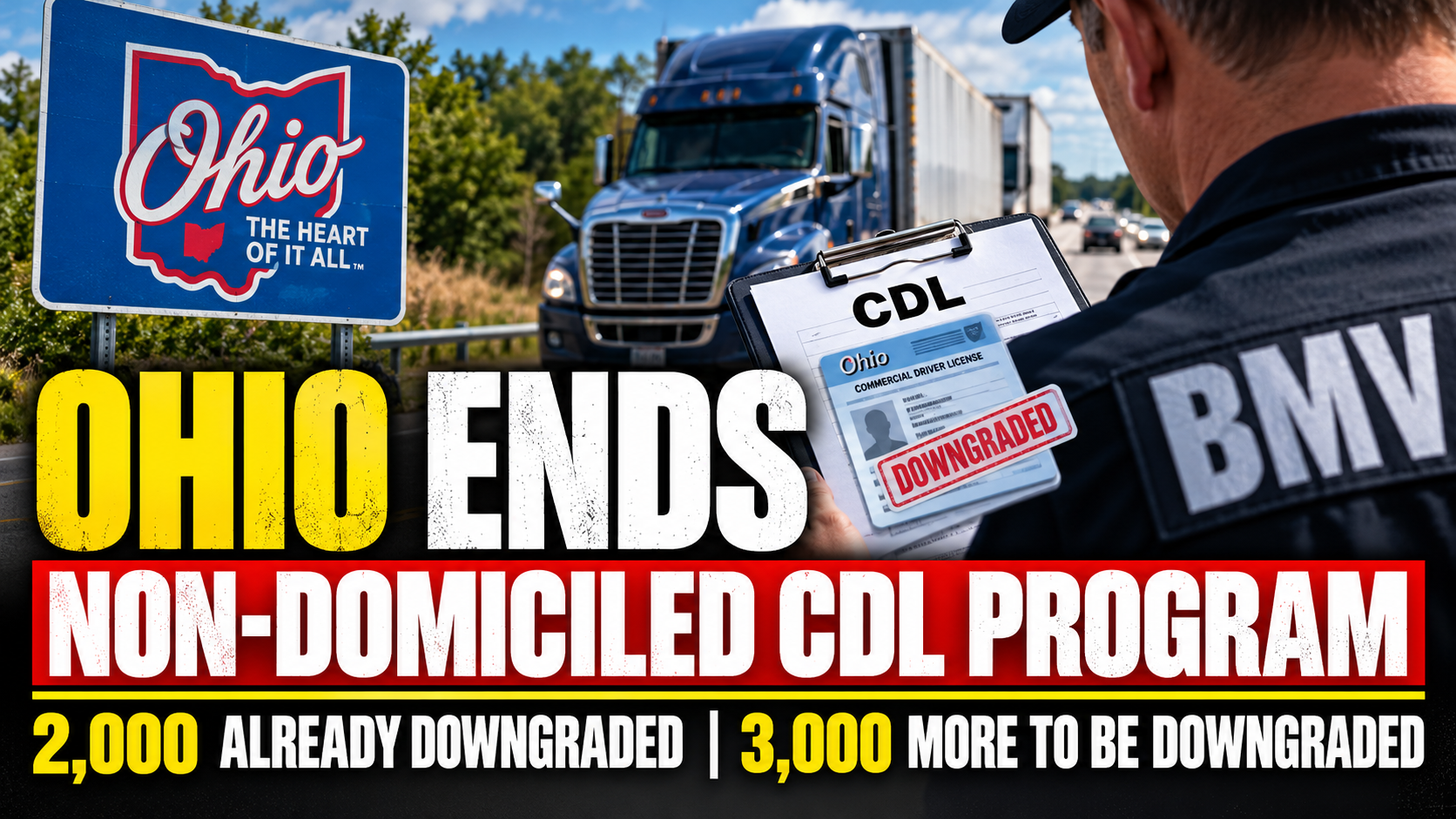
Ohio is officially ending its non-domiciled commercial driver's license program, with approximately 3,000 remaining CDL holders facing the loss of their commercial driving privileges under a decision announced by the Ohio Bureau of Motor Vehicles.
The decision follows a statewide review of approximately 5,000 non-domiciled CDL holders conducted in response to updated federal commercial-driver licensing requirements.
According to the Ohio BMV, approximately 2,000 non-domiciled CDLs have already been downgraded to standard driver's licenses since May 2026.
The state now intends to downgrade the remaining credentials, bringing its non-domiciled CDL program to an end.
The Ohio BMV announced the decision on October 23, with additional statements from state officials and industry reporting appearing throughout the following week.
Approximately 5,000 CDL Credentials Reviewed
Ohio BMV Registrar Charlie Norman announced that the state was discontinuing its non-domiciled CDL program after reviewing the eligibility of approximately 5,000 credential holders.
The review was conducted in response to changes in federal requirements administered by the Federal Motor Carrier Safety Administration.
The state's findings and announced actions include:
Non-domiciled CDL credentials reviewed: Approximately 5,000.
CDLs already downgraded since May 2026: Approximately 2,000.
Remaining credentials subject to downgrade: Approximately 3,000.
New non-domiciled CDL issuance: Suspended since September 2025.
Non-domiciled CDL renewals: Suspended since September 2025.
Notice before additional downgrades: 30 days from the notification date.
Opportunity to request a hearing: Available to affected license holders.
The approximately 3,000 remaining licenses represent the difference between the state's rounded review and completed-downgrade figures. Ohio has not published an exact final count of outstanding credentials in its announcement.
The state also has not announced a single date when all remaining downgrades will be completed.
Remaining CDL Holders Will Receive Written Notice
The Ohio BMV stated that affected individuals will receive a letter notifying them of the downgrade.
According to the agency, the downgrade will become effective 30 days from the date of the notification letter.
Individuals may request a hearing with the BMV to dispute the downgrade in accordance with state and federal law.
This means the remaining commercial licenses have not necessarily all been downgraded as of October 30.
The administrative process remains underway, with individual effective dates determined by the notices issued to affected license holders.
Once a CDL is downgraded to a standard driver's license, the individual no longer holds the commercial driving privileges associated with that credential.
What Is a Non-Domiciled CDL?
A non-domiciled CDL is a federally regulated commercial driver's license issued under specific eligibility provisions to qualifying individuals whose circumstances do not meet the ordinary state-domicile requirements for a standard CDL.
These credentials have historically allowed certain legally present foreign nationals and other qualifying applicants to obtain commercial driving privileges in the United States.
Non-domiciled CDLs are distinct from ordinary CDLs issued to U.S. citizens and lawful permanent residents who satisfy standard state licensing requirements.
The Ohio BMV previously stated that its non-domiciled CDL reverification process did not apply to ordinary CDL holders or individuals with legally established permanent residence.
Ohio's current announcement concerns its non-domiciled CDL program, not a general cancellation of commercial driver's licenses throughout the state.
Federal CDL Requirements Prompted the Review
The Federal Motor Carrier Safety Administration revised non-domiciled CDL eligibility requirements beginning in September 2025 and subsequently adopted additional requirements through a 2026 final rule.
The federal changes tightened eligibility standards and documentation requirements for non-domiciled commercial driver's licenses and learner's permits.
Ohio began reviewing existing non-domiciled credentials to determine whether their holders continued to meet applicable requirements.
On May 29, 2026, the Ohio BMV announced that approximately 5,000 non-domiciled CDL holders would be contacted concerning their credentials.
At that time, the agency outlined procedures for notifying drivers whose documentation did not meet federal requirements and providing an opportunity to challenge a proposed downgrade.
The state had already stopped issuing and renewing non-domiciled CDLs following the September 2025 federal changes.
The October announcement goes further by ending the program entirely and directing that remaining non-domiciled credentials be downgraded.
The decision to discontinue the entire Ohio program is a state administrative action. It should not be confused with a federal determination that every non-domiciled CDL issued nationwide is invalid.
What This Means for Commercial Drivers and Motor Carriers
For affected drivers, the most immediate consequence is the potential loss of commercial driving privileges under their Ohio-issued credentials.
A driver whose CDL has been downgraded cannot continue operating a commercial motor vehicle that requires a CDL using that downgraded license.
Motor carriers employing affected drivers may also need to verify current licensing status before assigning commercial driving duties.
The Ohio action could create staffing and operational complications for carriers whose drivers hold the affected credentials.
However, the BMV has not released figures identifying how many of the approximately 3,000 remaining license holders are actively employed as commercial truck drivers, how many operate interstate, or how many work for Ohio-based carriers.
The announcement also does not establish that all affected drivers committed safety violations or engaged in fraudulent activity.
The action concerns the state's non-domiciled licensing program and eligibility requirements.
Ohio's Decision Comes Amid Broader CDL Oversight
Ohio is not the only state reviewing its non-domiciled CDL practices.
Federal licensing changes and compliance reviews have prompted additional states to reconsider how these credentials are issued and maintained.
According to October 30 reporting by Transport Topics, Louisiana and Wyoming have also discontinued non-domiciled CDL issuance, while Ohio is proceeding with downgrades of its remaining credentials.
The actions reflect increasing scrutiny of state commercial-driver licensing procedures and compliance with federal qualification requirements.
The specific licensing actions, eligibility standards, and administrative procedures may differ among states.
What Happens Next?
Ohio's decision to terminate its non-domiciled CDL program has been announced, but the final round of license downgrades remains an ongoing administrative process.
The BMV will notify remaining affected credential holders by letter, with downgrades scheduled to take effect 30 days after the date of each notice.
Affected individuals retain the opportunity to request a hearing.
As of October 30, 2026, the state has not published a final completion date or confirmed that all remaining licenses have been downgraded.
For the trucking industry, the immediate issue is the status of affected drivers' commercial operating privileges as Ohio completes its licensing actions.
Truck Stop Talk will continue following verified CDL qualification and enforcement developments affecting professional commercial drivers.
Sources
Ohio Bureau of Motor Vehicles, October 23, 2026: Ohio BMV Announces End of Non-Domiciled CDL Program
Ohio Bureau of Motor Vehicles, May 29, 2026: Ohio BMV Announces CDL Compliance Measures
Federal Motor Carrier Safety Administration: Non-Domiciled CDL 2026 Final Rule FAQs
Ohio House of Representatives, October 27, 2026: Statement on Ohio BMV Decision
Transport Topics, October 30, 2026: More States Halt Non-Domiciled CDL Programs