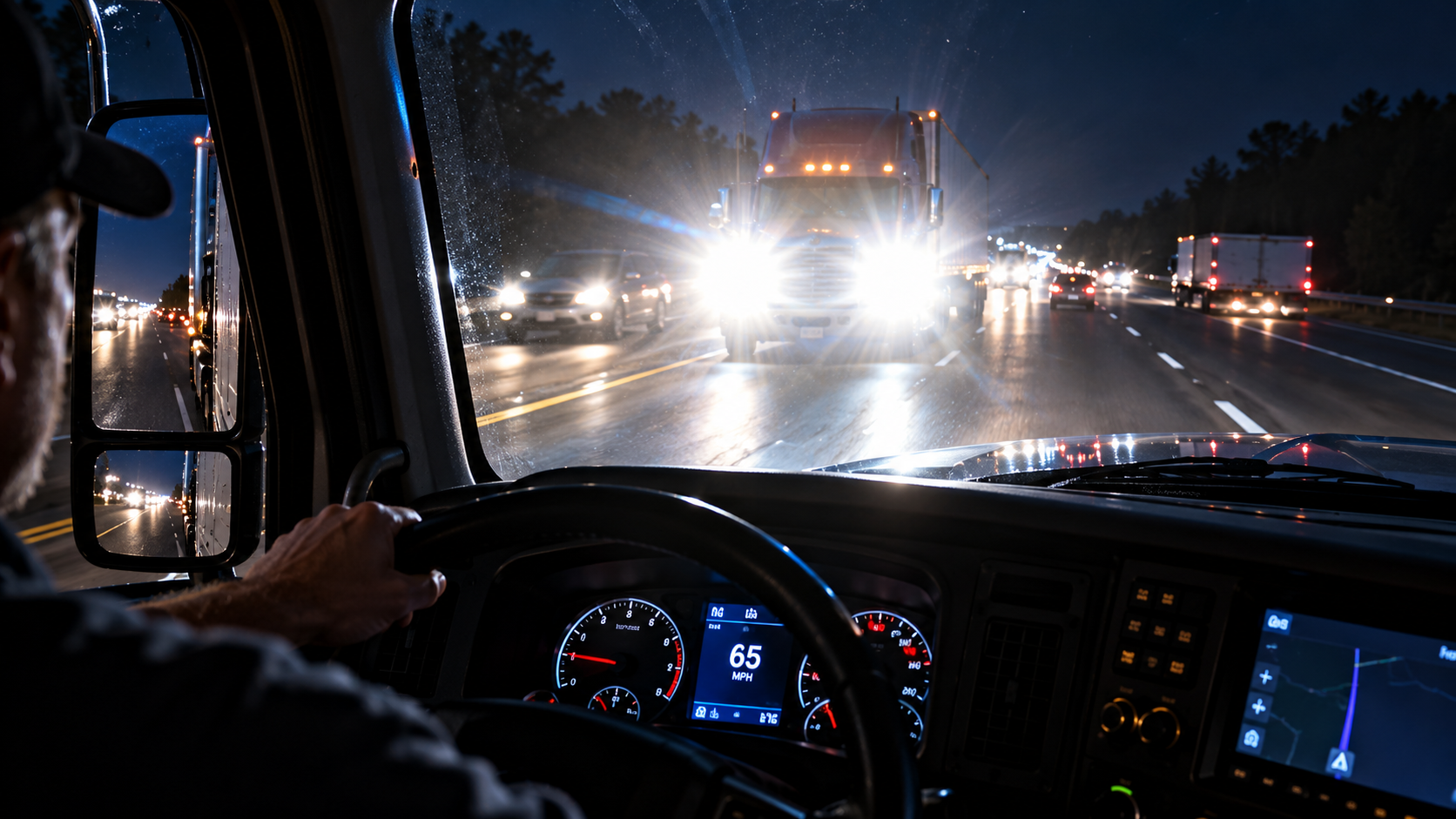
You're running down a two-lane highway at two in the morning. Traffic is light, the road is dark, and everything is going smoothly.
Then an oncoming vehicle comes over the hill with headlights so bright you can barely make out the pavement ahead.
For a few seconds, you're fighting the glare, trying to maintain your lane, and hoping there isn't a deer, disabled vehicle, or other hazard hiding beyond those lights.
If you've spent much time driving a truck at night, you know exactly what that feels like.
Headlight glare isn't simply an annoyance. It can temporarily interfere with a driver's ability to see the road, recognize hazards, and respond appropriately.
For professional truck drivers operating large, heavy vehicles at highway speeds, those few seconds deserve serious attention. Why Headlight Glare Is Such a Problem at Night Your eyes constantly adjust to changes in available light.
In darkness, your pupils enlarge to admit more light, helping you recognize objects and movement under low-light conditions.
When bright headlights suddenly enter your field of vision, that adjustment is disrupted.
The result can include discomfort, reduced contrast, temporary difficulty seeing objects, and lingering visual effects after the approaching vehicle has passed.
Safety researchers distinguish between two types of glare.
Discomfort glare makes bright lighting unpleasant or distracting.
Disability glare actually reduces a driver's ability to see important objects or details.
The distinction matters because a headlight can feel painfully bright without necessarily producing the same level of visibility impairment in every situation.
Both deserve attention, but disability glare presents the more direct visibility concern. Why Truck Drivers Experience Glare Differently A professional truck driver's seating position is considerably higher than that of someone driving a passenger car.
That changes the angles at which headlights, reflections, and other light sources enter the cab.
Depending on the roadway, vehicle height, headlight aim, and surrounding traffic, a truck driver may experience glare differently from someone sitting closer to the pavement.
The large windshield and exterior mirrors of a commercial truck can also introduce additional reflected light.
Wet pavement, rain, fog, and dirty glass can make matters worse.
Oncoming headlights may produce reflections across the roadway, while moisture or residue on the windshield scatters light and reduces visual clarity.
There is no single explanation for every glare complaint. Vehicle design, lighting technology, headlamp alignment, road geometry, and environmental conditions all contribute. Are LED Headlights the Problem? Modern LED headlights are frequently blamed for excessive glare.
LED technology can produce intense, sharply defined light, and some drivers find certain LED systems particularly uncomfortable.
But the type of bulb alone doesn't determine whether a headlight creates excessive glare.
Headlamp aim, mounting height, optical design, beam pattern, and the way a lighting system is installed can all affect what approaching drivers experience.
A properly designed and adjusted headlight system can improve nighttime visibility without unnecessarily directing light into other motorists' eyes.
An improperly aimed system can create problems regardless of whether it uses LED, halogen, or another lighting technology.
That is why the discussion should focus on how headlights perform on the road, not simply which technology produces the light. The Most Dangerous Reaction: Looking Directly at the Lights When an approaching vehicle's headlights are excessively bright, drivers sometimes instinctively look toward the source.
That can make the situation worse.
Instead, maintain awareness of your lane and direct your gaze toward the right edge of the roadway, using the lane markings or pavement edge as a visual reference.
Do not fixate on the headlights.
Keep scanning the roadway as visibility permits, and avoid sudden steering corrections.
If the glare significantly reduces your ability to see, ease off the accelerator and reduce speed smoothly.
Give yourself additional time to recognize hazards.
The objective isn't to prove you can maintain highway speed while temporarily struggling to see.
It's to remain in control until normal visibility returns. Don't Outdrive Your Headlights One of the most important principles of nighttime driving is maintaining a speed that allows you to recognize a hazard and stop within the distance you can see.
A fully loaded tractor-trailer requires substantial distance to stop, and that distance changes with vehicle weight, brake condition, tire condition, roadway surface, grade, and driver response.
At night, the available sight distance may be much shorter than during daylight.
Consider a dark rural highway with no streetlights.
A disabled vehicle, fallen debris, or animal may not become visible until it enters your headlight beam.
If you're traveling too fast for the available visibility, you may have very little time to react.
Headlight glare can make an already limited sight distance even shorter.
The posted speed limit is not a guarantee that the speed is appropriate for every nighttime condition. Keep Your Windshield and Mirrors Clean This sounds basic, but it makes a noticeable difference.
A windshield covered with road film, insects, dust, or interior residue can scatter light from approaching headlights.
The result may be halos, streaks, and reduced contrast.
Cleaning only the outside isn't always enough.
Interior windshield film can accumulate from dust, ventilation, and everyday cab use.
A thorough cleaning of both surfaces can improve visibility.
Exterior mirrors deserve the same attention.
Keep them properly adjusted and clean enough to provide a clear view of surrounding traffic without unnecessary distortion.
Drivers who wear glasses should also keep their lenses clean and use eyewear appropriate for nighttime driving. What About Yellow Night-Driving Glasses? Some products are marketed as solutions for headlight glare, particularly yellow- or amber-tinted glasses.
Drivers should be cautious about claims that these lenses improve nighttime driving safety.
Tinted lenses reduce the amount of light reaching the eyes, which can make it harder to detect pedestrians, animals, or poorly illuminated hazards.
Research has not established that yellow-tinted night-driving glasses provide a dependable improvement in nighttime hazard detection.
For drivers who experience significant glare, a comprehensive eye examination and properly prescribed clear lenses may be more useful than relying on products marketed as glare eliminators. Check Your Own Headlights, Too It's easy to complain about the headlights coming toward you.
But professional drivers should also consider the condition and adjustment of their own equipment.
Improperly aimed headlights can reduce useful road illumination and create unnecessary glare for other motorists.
During inspections and maintenance, pay attention to damaged headlamp assemblies, loose mounting components, cloudy lenses, and obvious alignment problems.
Replacement lighting equipment should be appropriate for the vehicle and comply with applicable requirements.
Installing a brighter bulb or aftermarket lighting assembly doesn't automatically produce a safer lighting system.
A poorly matched component may scatter light in directions the original assembly was never designed to control. Rain, Fog, and Wet Pavement Change the Equation Rain and fog can make nighttime glare especially challenging.
Wet pavement reflects approaching headlights and roadside lighting, sometimes making lane markings more difficult to distinguish.
Fog scatters light and reduces the distance at which objects become visible.
High beams can worsen visibility in fog because more light reflects back toward the driver.
In those conditions, use appropriate low-beam lighting, reduce speed, increase following distance, and avoid unnecessary abrupt maneuvers.
When visibility becomes too poor to continue safely, find a suitable location to stop.
A professional driver doesn't gain anything by pushing through conditions that no longer allow safe vehicle control. Fatigue Makes Night Driving Even Harder Headlight glare is only one part of nighttime driving risk.
Fatigue can reduce alertness, slow reaction time, and interfere with decision-making.
Drivers operating during the overnight hours may already be working against their natural sleep-wake cycle.
Combine that with darkness, repetitive highway scenery, limited traffic, and intermittent headlight glare, and the demands on the driver increase.
If you're struggling to stay alert, the answer isn't another energy drink and a louder radio.
Find a safe place to stop and obtain adequate rest.
Hours-of-service compliance is important, but being legally available to drive does not necessarily mean you're sufficiently alert to drive safely. Practical Habits That Reduce Nighttime Driving Risk Professional drivers can reduce their exposure to nighttime hazards by consistently following several practices:
- Adjust speed to actual visibility rather than relying exclusively on the posted limit.
- Avoid staring into approaching headlights.
- Keep the windshield, mirrors, and headlight lenses clean.
- Maintain a following distance that allows adequate reaction time.
- Inspect headlight condition and report alignment problems.
- Use high beams only when appropriate and dim them for other traffic.
- Avoid unnecessary distractions during periods of reduced visibility.
- Recognize fatigue early and stop when alertness becomes compromised.
These habits don't eliminate glare, but they help drivers maintain a margin of safety when visibility deteriorates. The Bottom Line Headlight glare is a real concern for professional drivers, particularly on dark highways, wet roads, and during overnight operations.
Modern lighting technology continues to evolve, but no lighting system can eliminate every visibility problem.
Drivers still have to manage their speed, maintain their equipment, and respond appropriately when approaching lights interfere with their view.
You can't control how every other vehicle's headlights are aimed.
You can control how you respond when those lights make it harder to see.
And when you're responsible for 70 or 80 feet of equipment traveling down the highway, that response matters.
Safety and Research References
- National Highway Traffic Safety Administration (NHTSA)
- Federal Motor Carrier Safety Administration: Large Trucks and Buses
- Federal Highway Administration: Roadway Safety
- National Library of Medicine: PubMed
This article provides general driver-safety education and is not a substitute for applicable traffic laws, carrier safety procedures, or medical advice.