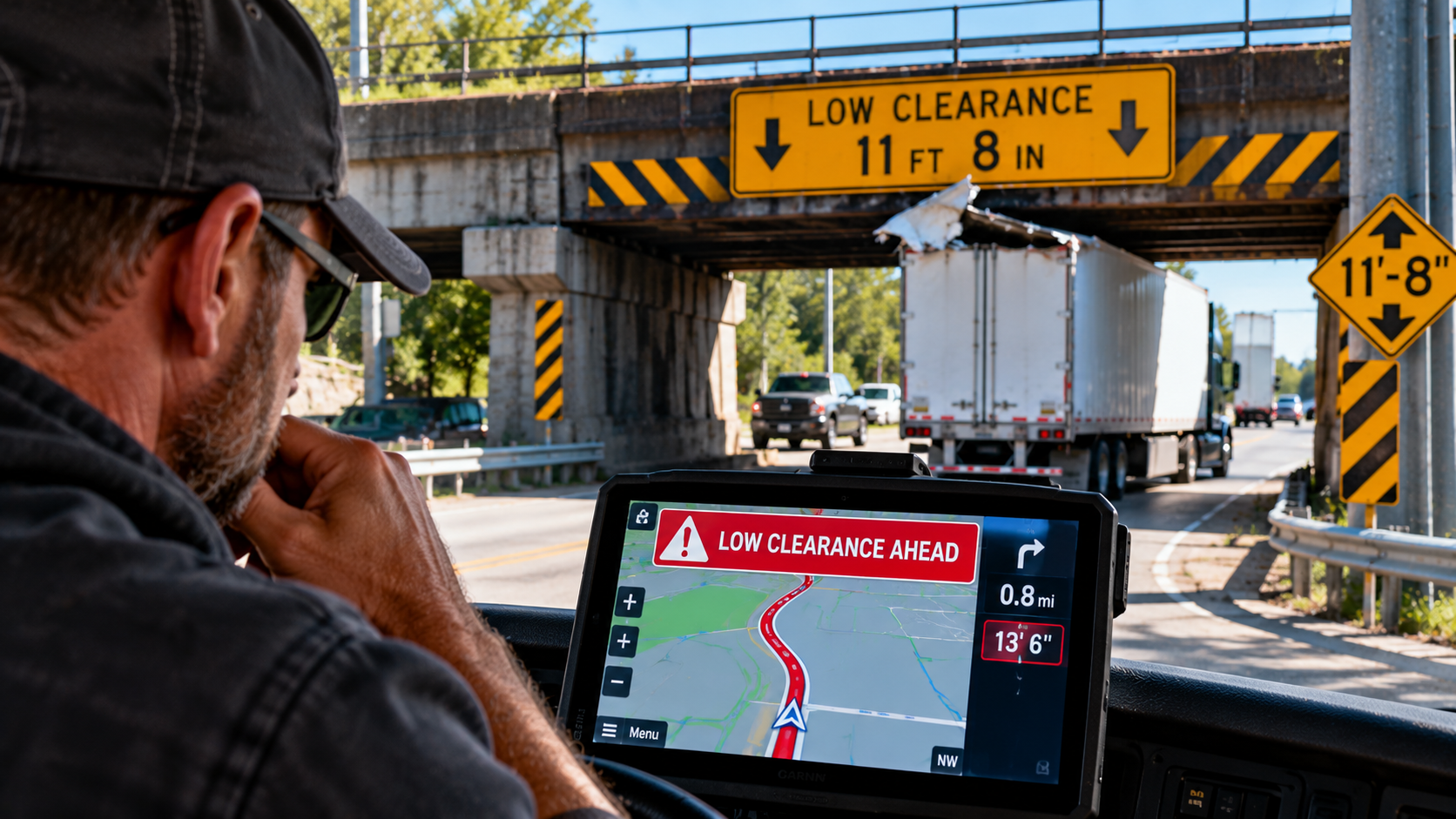
You're following your GPS through an unfamiliar city. Everything looks fine until you make a turn onto a narrow street.
Then you see it.
A railroad bridge ahead with a clearance sign that reads 12 feet, 4 inches.
You're driving a tractor-trailer that's approximately 13 feet, 6 inches tall.
Now you've got a problem.
There's no room to turn around. Traffic is stacking up behind you. Cars are parked along the curb, and backing out could put somebody in danger.
And that GPS you were following?
It's still telling you to proceed straight ahead.
Situations like this happen to professional drivers across the country. Sometimes the driver recognizes the problem in time. Other times, the result is a damaged trailer, a struck bridge, a blocked roadway, or a very expensive recovery operation.
A GPS can help you find a route. It cannot take responsibility for where that route leads. When Technology Sends a Truck Where It Doesn't Belong In October 2026, Indianapolis police raised concerns about recurring problems involving commercial trucks approaching a low-clearance bridge on South Meridian Street.
The reported clearance was 12 feet, 4 inches.
According to local reporting, some drivers approached the bridge before realizing their equipment could not safely pass underneath. Others recognized the restriction but found themselves in situations requiring police assistance to get turned around or redirected.
The problem wasn't limited to whether a truck actually struck the bridge.
Even stopping short of a low overpass can create traffic hazards when a large commercial vehicle has no safe way to reverse course.
The Indianapolis situation illustrates a problem that professional drivers encounter nationwide.
A route that works perfectly well for a passenger car may be completely unsuitable for a tractor-trailer. Not All GPS Navigation Is Designed for Trucks Most passenger-car navigation applications are built primarily around ordinary vehicle travel.
They may calculate routes using distance, estimated travel time, traffic conditions, and available roads.
But those calculations do not necessarily account for commercial vehicle restrictions.
A route may include a low bridge, a weight-restricted road, a prohibited truck route, or an intersection that cannot safely accommodate a long combination vehicle.
Truck-specific navigation systems are designed to consider additional information, such as vehicle height, weight, length, and applicable routing restrictions.
That makes them more appropriate for commercial vehicle operations.
However, even a dedicated truck GPS has limitations.
Road construction, temporary restrictions, outdated mapping information, incorrectly entered vehicle dimensions, and changing roadway conditions can all affect routing accuracy.
Truck-specific navigation is a valuable tool, but it is not a substitute for professional judgment. Know Your Equipment Before You Plan the Route A navigation system can only account for the vehicle information it has.
Drivers should know the dimensions and operating limitations of their equipment.
That includes:
- Overall vehicle height.
- Vehicle and combination length.
- Actual and applicable gross weight.
- Axle and axle-group weights.
- Trailer configuration.
- Hazardous materials restrictions, when applicable.
- Other equipment-specific routing limitations.
A standard dry van or refrigerated trailer may commonly operate near 13 feet, 6 inches in overall height, but that should never be assumed for every truck.
Specialized equipment, high-cube configurations, oversized loads, and changes in equipment can produce different dimensions.
Drivers must verify the actual height of the vehicle they are operating.
Entering the wrong information into a truck GPS can result in routing recommendations that are unsuitable for the equipment. Bridge Clearance Signs Are Not Suggestions When a driver approaches a posted low-clearance structure, the posted restriction must be taken seriously.
Never assume there is enough extra room to squeeze through.
Bridge-clearance measurements and signage practices can vary by jurisdiction. Road resurfacing, snow accumulation, vehicle configuration, and other conditions may affect the available clearance.
A driver also cannot safely judge clearance simply by looking at the structure from the cab.
If your vehicle exceeds the posted clearance, do not attempt to pass underneath.
And if the clearance is uncertain, stop somewhere safe and verify it before proceeding.
Trying to save a few minutes by taking a chance under a bridge can result in equipment damage, infrastructure damage, injury, and serious legal consequences. Weight Restrictions Matter Just as Much Low bridges get plenty of attention because the consequences are immediately visible.
But weight-restricted roads and bridges present another serious routing concern.
A navigation system may direct a truck onto a roadway that cannot legally or safely accommodate its weight.
Some restrictions apply to gross vehicle weight. Others concern individual axles, axle groups, or particular bridge structures.
A route that is legal for an empty tractor-trailer may not be appropriate for the same equipment when loaded.
Drivers should verify the restrictions that apply to their actual vehicle and load.
Special permits may authorize certain movements, but those permits can include specific routes, travel conditions, and limitations.
A GPS-generated route does not override posted restrictions or permit requirements. The Last Few Miles Can Be the Most Dangerous Interstate travel is often relatively straightforward.
The trouble frequently begins after leaving the interstate.
A warehouse may be located in an industrial district surrounded by residential streets, older bridges, narrow intersections, or roads with commercial vehicle restrictions.
The shortest route to the shipping address may not be the designated truck entrance.
Some facilities have separate entrances for employee parking, passenger vehicles, receiving docks, and commercial deliveries.
A GPS may direct the driver toward the office entrance rather than the truck gate.
Before entering an unfamiliar area, verify the facility's truck entrance and any special approach instructions.
Use official truck routes and available facility directions when appropriate.
If the delivery instructions conflict with posted restrictions, stop and clarify the situation before proceeding. What to Do When You Discover a Low Bridge Ahead Suppose you've already turned onto the wrong road and discover a low bridge ahead.
Your first priority is preventing a collision.
Do not attempt to squeeze underneath the structure.
Do not make an impulsive U-turn across traffic or drive onto a sidewalk simply to escape the situation.
Instead:
Stop before the hazard. Choose the safest available position, activate the appropriate warning equipment, and avoid creating additional danger.
Assess the surroundings. Look for traffic, pedestrians, parked vehicles, intersections, and other obstacles.
Contact the appropriate authorities when necessary. If you cannot safely turn around or continue, law enforcement or local traffic authorities may need to assist.
Do not blindly back up. Reversing a tractor-trailer on a public roadway can create serious risks, particularly when visibility is limited.
Follow authorized directions. If traffic control or assistance is required, wait for appropriate personnel rather than improvising a dangerous maneuver.
The exact response depends on the location and circumstances.
But one principle remains constant.
A traffic delay is better than putting a trailer into a bridge. Don't Follow Another Truck Without Checking Drivers sometimes assume that if another tractor-trailer uses a particular road, the route must be acceptable.
That can be a dangerous assumption.
The other truck may have a different height, weight, length, or configuration.
It may be traveling empty, operating under a permit, or making a local delivery under an applicable exception.
It may also be taking a route it shouldn't.
The fact that another driver made the turn does not establish that your equipment can legally or safely follow.
Every driver is responsible for evaluating the route for the vehicle being operated. Use More Than One Source When Planning Good trip planning doesn't require abandoning technology.
It requires using the right tools and understanding their limitations.
A truck-specific GPS or navigation application can be an excellent starting point.
Official state DOT truck-route information, current road restrictions, commercial vehicle atlases, permit instructions, and shipper or receiver directions can provide additional information.
Before departure, pay particular attention to unfamiliar urban areas, the final approach to the destination, known construction zones, and any roads with unusual restrictions.
Drivers should also remain alert for temporary signs and traffic-control devices that may not appear in electronic maps.
And remember that satellite imagery or street-level photographs may be outdated.
A roadway shown as accessible online may have changed since the image was captured. Why Experienced Drivers Still Make Routing Mistakes It's easy to assume that only inexperienced drivers end up under low bridges or on restricted roads.
That's not necessarily true.
An experienced driver may be dealing with a last-minute destination change, unfamiliar customer, road closure, detour, or incorrect facility address.
Fatigue, time pressure, distractions, and overconfidence can contribute to poor decisions.
The difference is often how quickly the driver recognizes the problem and responds.
Professional driving requires knowing when to question the route, verify the information, and stop before a manageable situation becomes a collision.
No amount of experience makes a driver immune to a bad GPS instruction. The Bottom Line GPS navigation has made commercial driving more convenient, but it hasn't eliminated the need for trip planning.
Low bridges, weight restrictions, narrow roads, and unsuitable delivery approaches remain real hazards.
Know your equipment. Use truck-appropriate navigation. Verify unfamiliar routes. Watch posted signs.
And when the technology tells you to go somewhere your truck doesn't belong, trust the roadway restrictions rather than the screen.
Because when that trailer hits a bridge, the GPS isn't the one getting the citation.
References and Driver Resources
- Federal Motor Carrier Safety Administration: Commercial Driver's License Program
- Federal Highway Administration: Freight Management and Operations
- Federal Highway Administration: Truck Size and Weight
- CDLLife: Indianapolis Police Urge Truckers to Plan Their Routes, October 20, 2026
This article provides general educational information. Drivers must follow applicable state and local traffic restrictions, posted signs, permit conditions, and official traffic-control instructions.